
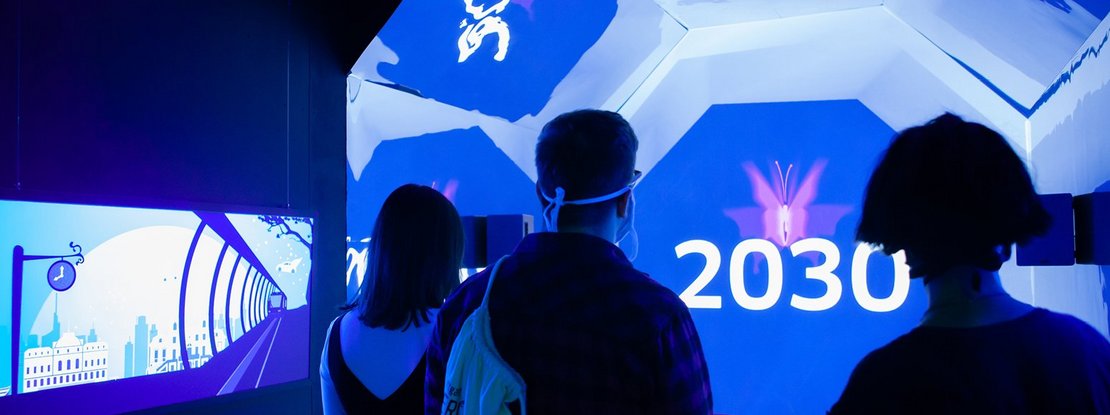


The StadtPalais – Museum für Stuttgart is a city museum of a special kind. One gets the impression that it is constantly reinventing itself. This is because the StadtPalais offers a wide variety of formats for getting to know Stuttgart and its history. With the escape exhibition “Stuttgart in Lost Time”, it is venturing into yet another unusual format that has never before been seen in the museum in this form. The Escape exhibition aims to raise visitors’ awareness of Stuttgart’s city history and bring it to life. The concept of the escape room is not only to be integrated into the exhibition but also linked to it.
90 minutes. The length of a football match. In this short time, we want to convince visitors that history does not have to be dry and black-and-white. Rather, it can be colourful and multifaceted, and even fun. We want to whisk our audience away and take them on an exciting journey through the past and into the future. The focus is on conveying the message of self-efficacy: even the smallest things can change the world! The butterfly effect states that even the gentle flutter of a butterfly’s wings can trigger a tornado.
The town hall in 1744, the market square in 1312 and a marshland landscape in 950 – visitors will reach these stops via a futuristic, 16-metre-long time-travel train, which is to be situated in the middle of the StadtPalais. But what did it look like back then? The sets are being created in close collaboration with the historians from the StadtPalais, as everything must, of course, be authentic and historically accurate. We’ve also brought a set designer on board to provide us with advice and support. A slide takes visitors back to the present day – definitely a highlight for young and old.
We are writing puzzles and developing a hint system. The puzzles are solved at the hexagonal, interactive game tables, which are activated by an RFID time-travel ticket. The hint-giver also works using RFID technology. In addition to the time-travel ticket and the hint-giver, visitors will find further gadgets in their time-travel bag. With the help of these gadgets, they can solve the puzzles. To make the invisible visible, we work with UV ink and black light. We breathe life into the characters who accompany visitors on their journey through space and time. In a recording studio in Cologne, we meet with Meike Rosenplänter and Markus Dichmann from Deutschlandfunk Nova. There, we record the voice-over texts we have written. By using various media, we capture our audience’s attention. We also engage differentsenses in the various escape rooms.
Naturally, the public should hear about the escape exhibition. We develop a corporate design for print and online marketing. We design posters and banners for various purposes, a flyer, as well as graphics and animations for the website and social media channels.
The opening of the Escape exhibition is a resounding success. We see beaming faces and, a day later, we feature on the front page of the Stuttgarter Zeitung.

“VISUELL had an incredible wealth of ideas, and whenever I wanted to contribute my own ideas, they were always welcomed. You always have certain expectations of how things should turn out, but VISUELL usually managed to exceed them by a long way.”
Martin Seeburg,
Museum educator and co-curator,
StadtPalais – Museum of Stuttgart


