Skip to content
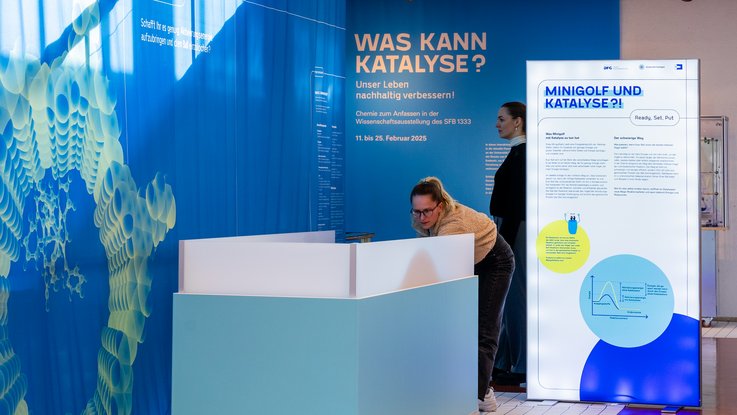
VISUELL Szenografie: Wissenschaftsausstellung: Eine Besucherin bedient eins der zwei interaktiven Exponate in der Ausstellung „Was kann Katalyse?“, daneben befindet sich eine Informationstafel mit Text und Bild
Project

Science exhibition: “What can catalysis do?” 

Client

University of Stuttgart, Collaborative Research Centre SFB 1333

Location

Stuttgart City Hall

Year

February 2025

Services

Concept, design, implementation, planning and construction of the exhibits, supervision, planning and support of production, key visual, external communications, print products

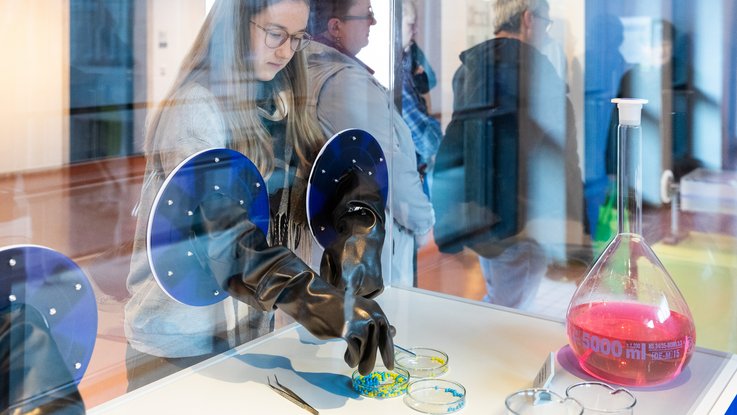
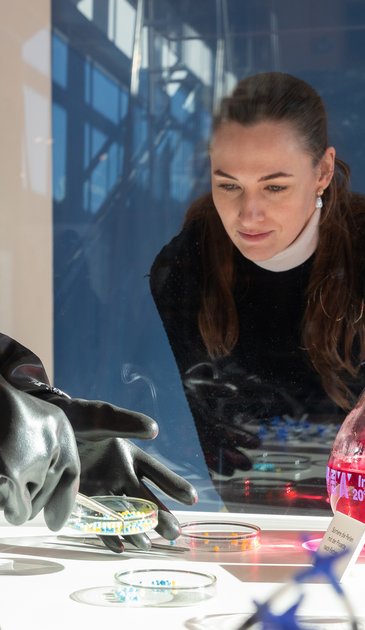
VISUELL Szenografie: Wissenschaftsausstellung: Eine Besucherin betrachtet aufmerksam ein Experiment in der Ausstellung „Was kann Katalyse?“. Sie schaut durch eine Glasvitrine auf eine Petrischale mit bunten Perlen. In der Vitrine sind Handschuhe zu sehen, mit denen eine Person das Experiment durchführt. Ein Informationsschild neben der Petrischale erklärt das Experiment.
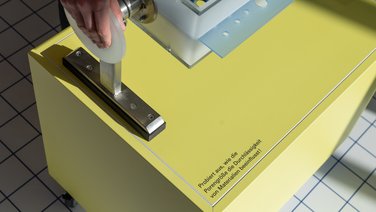
VISUELL Szenografie: Wissenschaftsausstellung: Detailaufnahme eines interaktiven Exponats zu Selektionsmechanismen in der Ausstellung „Was kann Katalyse?“. Eine Hand bedient das drehbare Exponat, welches darstellt wie die Porengröße die Durchlässigkeit von Materialien beeinflusst.
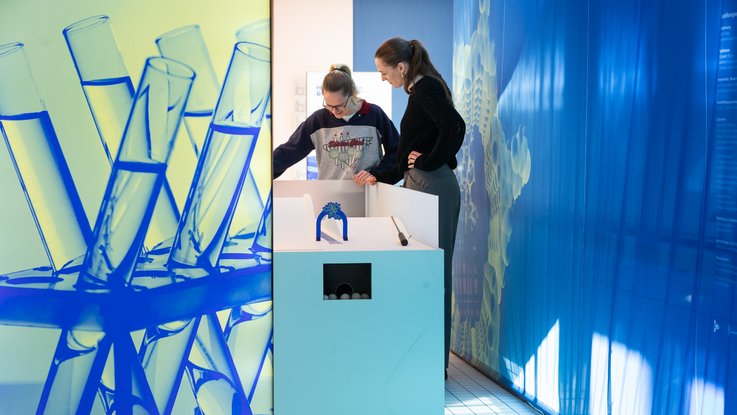
VISUELL Szenografie: Wissenschaftsausstellung: Zwei Besucherinnen interagieren mit einem interaktiven Exponat in der Wissenschaftsausstellung „Was kann Katalyse?“. Im Hintergrund sind großflächige, blaue Abbildungen von Reagenzgläsern und chemischen Strukturen zu sehen.

VISUELL is producing the interactive exhibition “What can catalysis do? Improving our lives sustainably!” The Collaborative Research Centre SFB 1333 at the University of Stuttgart aims to use the exhibition to explain complex catalytic processes in a practical way and to raise awareness of chemistry and catalysis in everyday life. The focus is on the interactivity of the exhibits, which enable visitors to grasp complex scientific processes in a playful way. School classes from Year 10 onwards, as well as the interested public, gain a direct insight into the research of SFB 1333. 

As part of the concept optimisation, we are adapting the original exhibition concept to the conditions of Stuttgart Town Hall. A modular spatial concept creates islands which, through floor coverings and large-scale banners, form a scenography that evokes associations with chemistry lessons. Light boxes serve as information displays and a wayfinding system. The mobile and space-saving exhibition design allows for the flexible use of the exhibits, for example at events such as Girls’ Day or the Science Festival. The concept is complemented by the character “Paul, the Pore”, who provides young visitors with additional age-appropriate information. 

The design concept is based on the colours of the University of Stuttgart and the accent colours of the Science Festival. In addition to the exhibition design, we are developing the key visual and handling all external communications, from flyers and posters to modern moving image formats. 

With this project, we can once again demonstrate that, even when faced with unexpected challenges, urban planning requirements and fire safety regulations, we think flexibly and with foresight out of the box and realise a technically precise and interactive exhibition experience.
VISUELL Szenografie: Wissenschaftsausstellung: Nahaufnahme einer Beschriftung „Wie Chemiker*innen arbeiten“ in dunkelblauer Schrift auf weißem Hintergrund in der Wissenschaftsausstellung „Was kann Katalyse?“.

“Our collaboration with VISUELL was excellent throughout the entire project. The project team demonstrated impressive creativity and flexibility, thereby making a decisive contribution to the success of the exhibition. We would be delighted to work with VISUELL on further projects in the future.”

Yasemin Polikar
Project Lead for “What Can Catalysis Do?
Collaborative Research Centre SFB 1333 at the University of Stuttgart
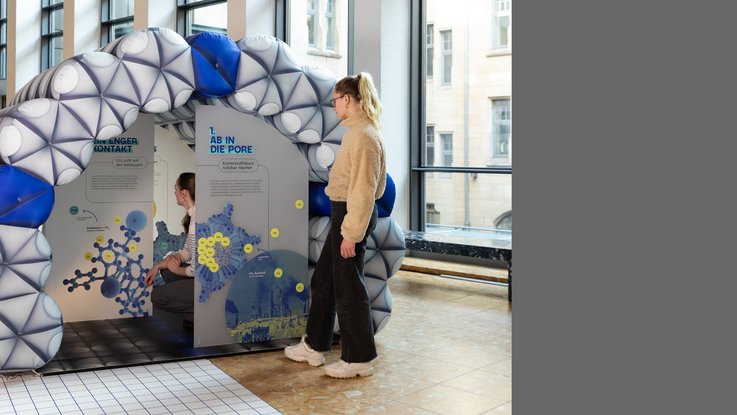
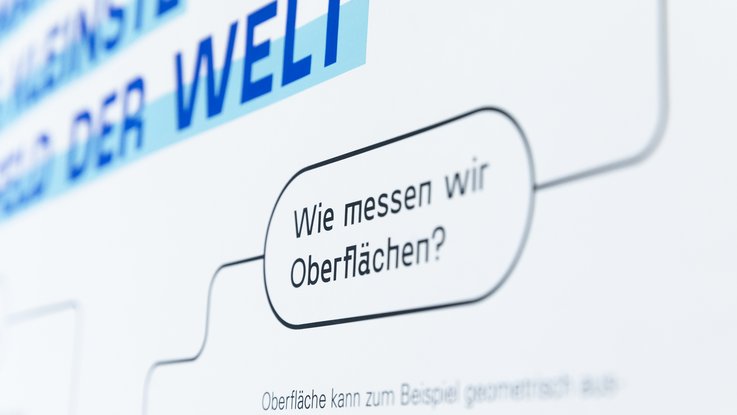
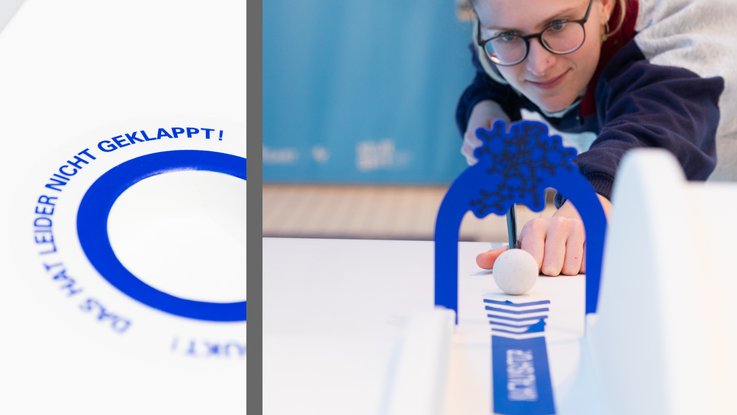
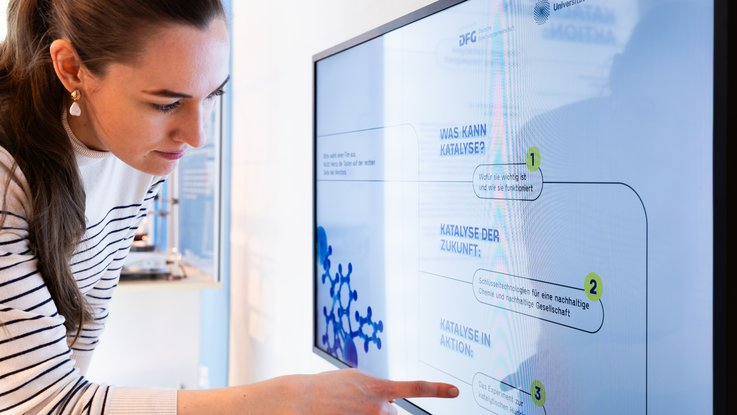
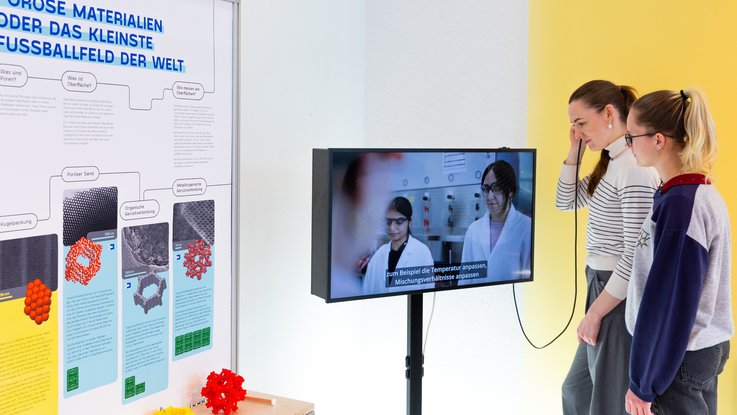
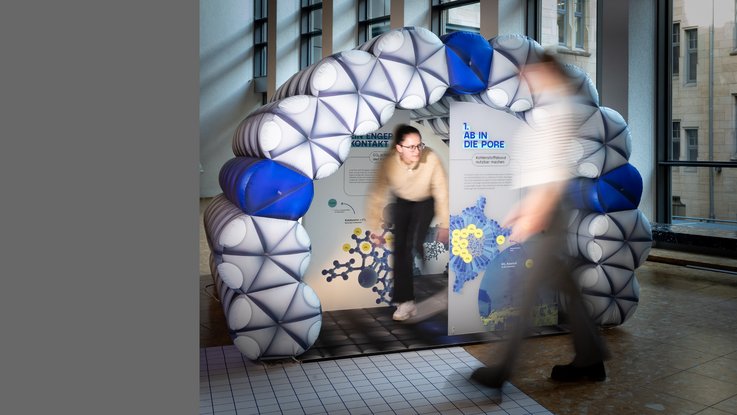
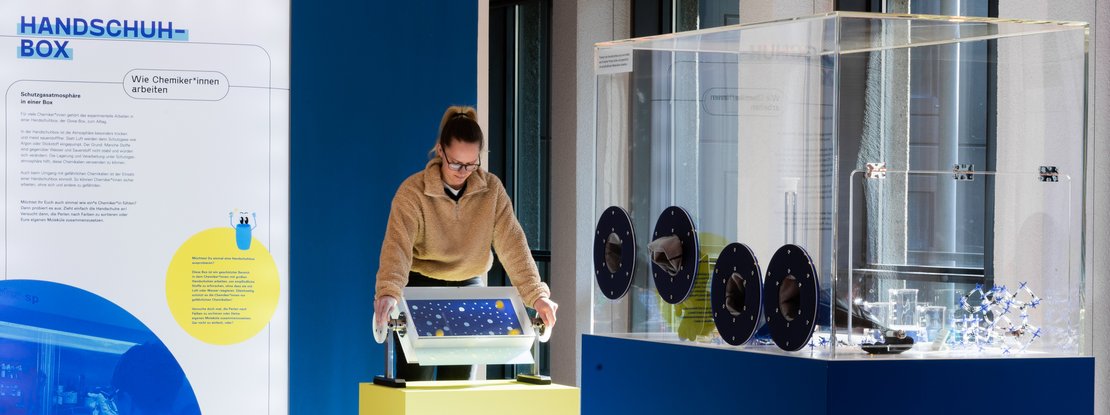
VISUELL Szenografie: Eine Besucherin betrachtet ein begehbares, aufgeblasenes Modell einer Pore in der Wissenschaftsausstellung „Was kann Katalyse?“. Die Struktur des Modells besteht aus Molekülen und ist als Bogen aufgebaut. Im Inneren der Pore befindet sich eine Informationstafel mit dem Titel „Ab in die Pore“. Eine weitere Besucherin befindet sich im Inneren der Pore.VISUELL Szenografie: Wissenschaftsausstellung: Nahaufnahme einer Beschriftung „Wie messen wir Pberflächen“ in schwarzer Schrift auf weißem Hintergrund in der Wissenschaftsausstellung „Was kann Katalyse?“.VISUELL Szenografie: Wissenschaftsausstellung: Nahaufnahme einer Hand, welche das Exponat „Minigolf und Katalyse“ mit einem Schläger bedient. Das Exponat ist weiß, in der Mittel befindet sich ein blauer Pfeil mit der Aufschrift „Katalyse“ und ein blaues Tor, durch welches die Besuchenden im besten Fall den Ball spielen sollten.VISUELL Szenografie: Wissenschaftsausstellung: Eine junge Besucherin bedient die interaktive Handschuhbox in der Ausstellung „Was kann Katalyse?“, sie hat beide Arme in den Handschuhen und sortiert mit einer Pinzette blaue und gelbe Kugeln in Petrischalen, im Hintergrund sieht man weitere BesuchendeVISUELL Szenografie: Wissenschaftsausstellung: Zwei Besucherinnen stehen neben den Exponaten der Wissenschaftsausstellung „Was kann Katalyse?“. Eine Besucherin bedient das Exponat „Minigolf und Katalyse“ mit einem Schläger, daneben steht eine Informationstafel zu diesem Thema dazu. Die andere Besucherin steht im Hintergrund und betrachtet die blauen Stoffbanner mit weiteren Informationen.VISUELL Szenografie: Wissenschaftsausstellung: Links: Detailaufnahme einer blauen Beklebung des Exponats „Minigolf und Katalyse“. Rechts: Frontale Nahaufnahme einer Besucherin die dieses Exponat mit einem Schäger bedient und durch einen blauen Bogen zielt.VISUELL Szenografie: Wissenschaftsausstellung: Nahaufnahme einer Besucherin die vor einem Bildschirm steht und auf Elemente der dort abgespielten Informationsgrafik zeigt.VISUELL Szenografie: Wissenschaftsausstellung: Zwei Besucherinnen stehen vor einer Bildschirmstele und verfolgen den abgespielten Film, eine von ihnen hält einen Handkopfhörer an ihr Ohr. Daneben befindet sich ein Plakat mit Informationen und mehrere Modelle von Molekülstrukturen von unterschiedlichen Materialien.VISUELL Szenografie: Eine Besucherin steht in einem begehbaren, aufgeblasenen Modell einer Pore in der Wissenschaftsausstellung „Was kann Katalyse?“. Die Struktur des Modells besteht aus Molekülen und ist als Bogen aufgebaut. Im Inneren der Pore befindet sich mehrere Informationstafeln. Eine weitere Besucherin läuft im Vordergrund an dem Exponat vorbei.